
Money & grants
EC Downpayment: How Much Cash Do You Need? A $1.5M Example

You have found an executive condominium (EC) you like and the next question is practical: how much cash must you have ready? This guide answers "ec downpayment how much cash" with one worked example. The figures below use a hypothetical $1,500,000 purchase price. It is an example, not a quote for any project.
EC downpayment: how much cash do you need at the start?
Under the normal payment scheme you need at least 5% of the price in cash. On a $1,500,000 EC that is $75,000. A further 20% can come from cash or CPF early in construction. You also pay Buyer's Stamp Duty. Costs vary by project, so treat these as a planning guide.
The 5% is the minimum cash downpayment. You cannot cover it from CPF. The remaining 20% is where your CPF Ordinary Account helps, within CPF's usage limits.
How is the downpayment split on a $1,500,000 EC?
The bank lends up to 75% of the price for a first housing loan. That leaves 25% for you to fund. Of that, 5% must be cash and 20% can be cash or CPF. The numbers below are for the example price only.
| Item | Share of price | Amount |
|---|---|---|
| Bank loan (first housing loan) | 75% | $1,125,000 |
| Minimum cash downpayment | 5% | $75,000 |
| Cash or CPF, early in construction | 20% | $300,000 |
| Your total share before the loan | 25% | $375,000 |
ECs are financed with bank loans only. An HDB loan is not available. Your monthly instalment also has to fit within the Mortgage Servicing Ratio, which caps it at 30% of gross household income.
How much Buyer's Stamp Duty will you pay?
On a $1,500,000 purchase, Buyer's Stamp Duty is $44,600, reported from the published bands. It is charged in slices: 1% on the first $180,000, 2% on the next $180,000, 3% on the next $640,000 and 4% on the next $500,000.
Here is the working for each slice. The sum is $1,800 + $3,600 + $19,200 + $20,000 = $44,600.
HDB owners buying a new EC do not pay Additional Buyer's Stamp Duty, provided they sell their flat within six months of collecting the EC keys.
Adding it up, the main early payments on the example EC come to $419,600: the $75,000 cash downpayment, the $300,000 from cash or CPF, and the $44,600 stamp duty. Legal fees and other costs are not included.
Can I use CPF and the EC grant towards the downpayment?
Yes, in part. After the minimum 5% cash, you can use your CPF Ordinary Account for the rest of the downpayment and for monthly instalments, within CPF's limits. The EC CPF Housing Grant is reported to be paid into the same account, so it helps with that part.
First-timer families can get up to $30,000. It is $30,000 at a household income of $10,000 or less, $20,000 at $10,001-$11,000 and $10,000 at $11,001-$12,000. Above $12,000 there is no grant.
The Enhanced CPF Housing Grant is for HDB flats only. It does not apply to ECs, so do not budget around it.
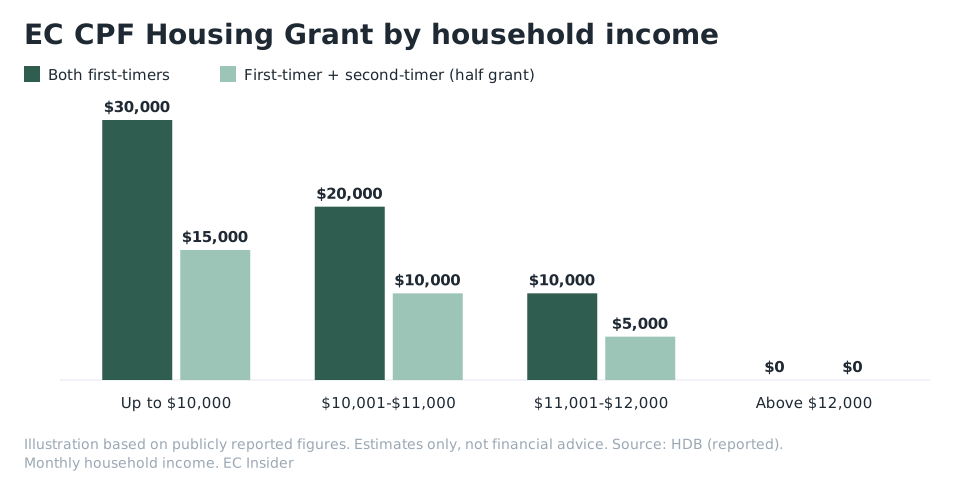
If one of you is a second-timer, the grant is halved: up to $15,000 at $10,000 or less, down to $5,000 at $11,001-$12,000. A couple who are both second-timers receive none.
How does the Deferred Payment Scheme change the cash you need?
Under the Deferred Payment Scheme (DPS) you pay about 20% of the price when you book and sign, and the remaining 80% at Temporary Occupation Permit (TOP). There are no progressive payments during construction. On the example price, 20% is $300,000 and the 80% balance is $1,200,000.
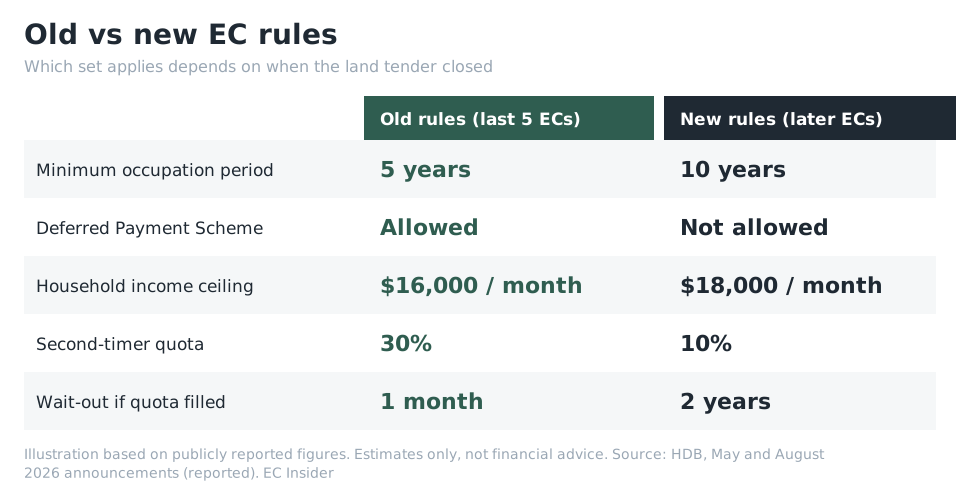
DPS is reported to be available only on the five old-rule ECs, and each developer decides whether to offer it. Solano Grand, Wynwood Grand, Clovelle of Woodlands, Sembawang Road EC and Miltonia Close EC are in that group. Sites tendered from 8 May 2026 have no DPS.
Developers usually price DPS units 2-3% above the normal scheme. At 2.5% on the example price, that is $37,500 more. Whether it pays off depends on the bank interest you would otherwise face during construction.
What should you check before you budget?
Three checks keep the plan honest. First, confirm which rule set your EC follows. Second, check your income against the $16,000 ceiling for old-rule ECs, or $18,000 for sites tendered from 24 August 2026, and against the $12,000 grant cut-off. Third, ask the sales team which payment schemes their units carry.
Remember that the grant, stamp duty and loan limits are all reported figures that can change. Check HDB and the project's price list before you commit.
What is your next step?
Your own numbers matter more than any example. Put your income, savings and CPF balance into the EC affordability calculator to see your real cash requirement. Then read the grants guide and the DPS guide to see which scheme fits your cash position.
This article is general information based on public sources at the time of writing. It is not financial advice. Policy figures and launch details can change, so confirm them with HDB, CPF Board, your bank and the developer.


