
Money & grants
EC Grant for First-Timers 2026: How Much You Get and How to Use It

The EC grant for first-timers in 2026 is smaller than many buyers expect, and it stops at a lower income than the EC ceiling. If you are planning your first executive condominium, get this number right before you set your budget. Here is how much you can receive, who qualifies, and how the money is paid.
How much is the EC grant for first-timers in 2026?
First-timer families buying a new EC from the developer can get a CPF Housing Grant of up to $30,000, paid into CPF Ordinary Accounts. It is $30,000 at a household income of $10,000 or less, $20,000 at $10,001-$11,000, $10,000 at $11,001-$12,000, and nothing above $12,000.
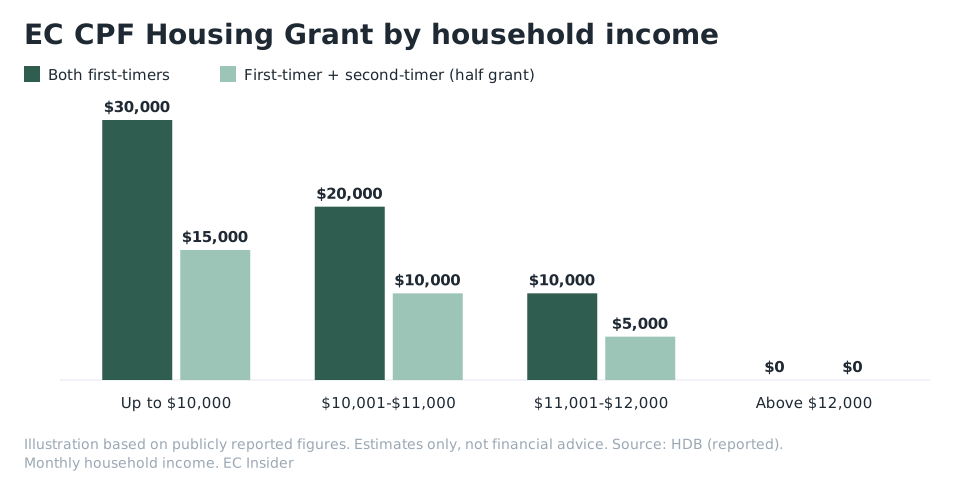
Income here is your average gross monthly household income. The bands are reported by HDB; confirm the figures that apply to you when you apply.
Can I get the Enhanced CPF Housing Grant (EHG) for an EC?
No. The Enhanced CPF Housing Grant is for HDB flats only. Executive condominiums have their own, smaller CPF Housing Grant, up to $30,000 for first-timer families. Many buyers plan around the EHG figure and find a gap in their downpayment, so check before you budget.
This is the most common budgeting mistake we see. A couple who qualified for a large EHG on a BTO flat should not assume the same support for an EC.
What if one of us is a second-timer?
A couple with one first-timer and one second-timer can get half the grant: up to $15,000 at a household income of $10,000 or less, tapering to $5,000 at $11,001-$12,000. Second-timer couples get no EC grant and may also pay a resale levy.

Second-timers do have one advantage on the last five old-rule ECs: up to 30% of units at launch can go to second-timer households, against 10% for ECs under the new rules.
Can singles get an EC grant?
Singles cannot buy an EC alone, but two or more singles aged 35 and above can apply together under the Joint Singles Scheme. No EC CPF Housing Grant is given to joint singles, so budget without it.
How is the EC grant paid, and what can it be used for?
The grant goes into your CPF Ordinary Accounts, not to the developer. You can then use it with the rest of your CPF savings towards the downpayment and the monthly instalments, after the minimum 5% cash downpayment, within CPF's usage limits.
Because it lands in CPF, the grant does not reduce the cash you need upfront. Under the normal payment scheme you still pay at least 5% of the price in cash, plus Buyer's Stamp Duty. On a $1.5M EC that is $75,000 in cash, $300,000 more from cash or CPF, and $44,600 in stamp duty.
Can I use CPF for the rest of the EC downpayment?
Yes. After the minimum 5% cash downpayment, you can use your CPF Ordinary Account for the rest of the downpayment and for the monthly instalments, within CPF's usage limits. The EC grant is added to that same Ordinary Account balance.
ECs are financed with bank loans only, not HDB loans, up to 75% of the price for a first housing loan. Your monthly instalment cannot exceed 30% of your gross household income under the Mortgage Servicing Ratio, so the grant helps most with the downpayment rather than the monthly bill.
Does the income ceiling for the EC differ from the grant limit?
Yes. You can buy one of the last five old-rule ECs with a household income of up to $16,000, and new-rule ECs from sites tendered after 24 August 2026 go up to $18,000. But the grant stops above $12,000, so many eligible buyers receive no grant at all.

What should you check before you book?
- Your band: work out your average monthly household income and find your grant band above.
- Your status: confirm whether each of you is a first-timer or a second-timer.
- Your cash: set aside at least 5% of the price in cash and the stamp duty, because the grant cannot cover them.
Read our full EC grants guide, then try the EC affordability calculator to see what price range your income and grant support.
This article is general information based on public sources at the time of writing. It is not financial advice. Policy figures and launch details can change, so confirm them with HDB, CPF Board, your bank and the developer.


