
News & rules
EC Old Rules vs New Rules 2026: MOP, DPS, Income Ceiling and Quotas Compared

The EC old rules vs new rules 2026 question decides what you can buy, how you pay and when you can sell. Two announcements in 2026 split executive condominiums into two groups, and which group a project falls into depends on one date: when its land tender closed. Here is every difference, side by side.
What are the EC old rules vs new rules in 2026?
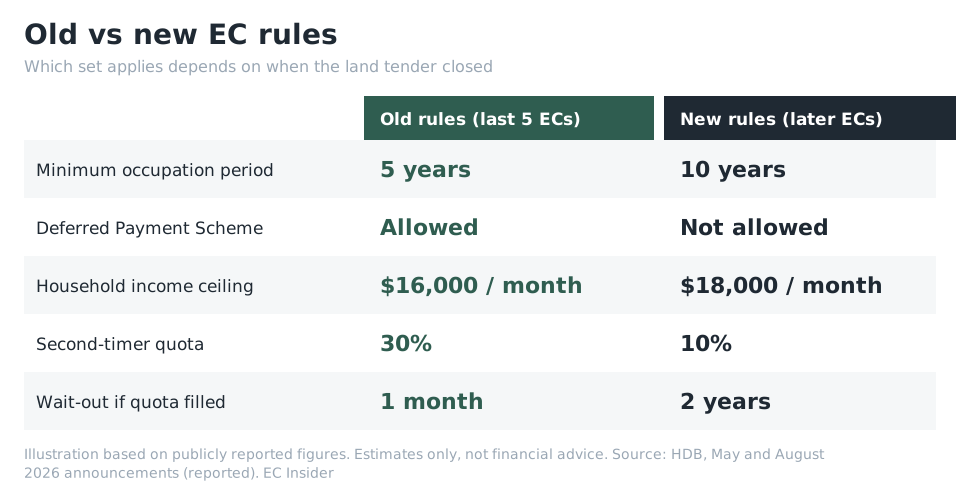
Old-rule ECs, on land tendered before 8 May 2026, keep a 5-year MOP, may offer DPS, use a $16,000 income ceiling and give second-timers up to 30% of units. New-rule ECs carry a 10-year MOP, no DPS, an $18,000 ceiling and a 10% second-timer quota.
The five old-rule ECs still to launch are Solano Grand, Wynwood Grand, Clovelle of Woodlands, Sembawang Road EC and Miltonia Close EC. The new-rule sites so far are Canberra Drive, Admiralty Walk and Jurong East Avenue 1.
What changed for ECs on 8 May 2026?
For EC sites whose land tender closed on or after 8 May 2026, the minimum occupation period doubles from 5 to 10 years, the Deferred Payment Scheme is removed, and the first-timer quota rises to 90%. Sites tendered before that date keep the old rules.
The aim was to keep ECs focused on owner-occupiers. DPS had let buyers commit with little paid upfront, and a longer MOP means fewer ECs are bought to sell on quickly.
Is the EC income ceiling $16,000 or $18,000?
It depends on the project. The last five old-rule ECs use a $16,000 monthly household income ceiling. EC sites whose land tender closes on or after 24 August 2026 use $18,000. The higher ceiling does not apply to balance units in existing ECs.
So, as an example, a household earning $17,000 a month cannot apply for Wynwood Grand or Solano Grand, but can apply for Canberra Drive and the ECs after it. The EC grant itself stops above $12,000 in both cases.
How do the second-timer quota and wait-out work?
Under the old rules, up to 30% of units at launch can go to second-timer households; once that quota is filled, second-timers face a one-month wait-out before buying the units left. Under the new rules the share falls to 10%, and the wait-out is two years.

For first-timer couples, the new rules mean better odds in the ballot. For second-timers, the last five old-rule ECs are the easier door: a bigger quota and a much shorter wait if it fills.
How does the 10-year MOP change your exit plan?
With a 5-year MOP you can sell an EC to Singapore Citizens and Permanent Residents five years after collecting the keys. With a 10-year MOP you wait twice as long, and the EC is fully privatised at the same point, so it can then be sold to anyone.
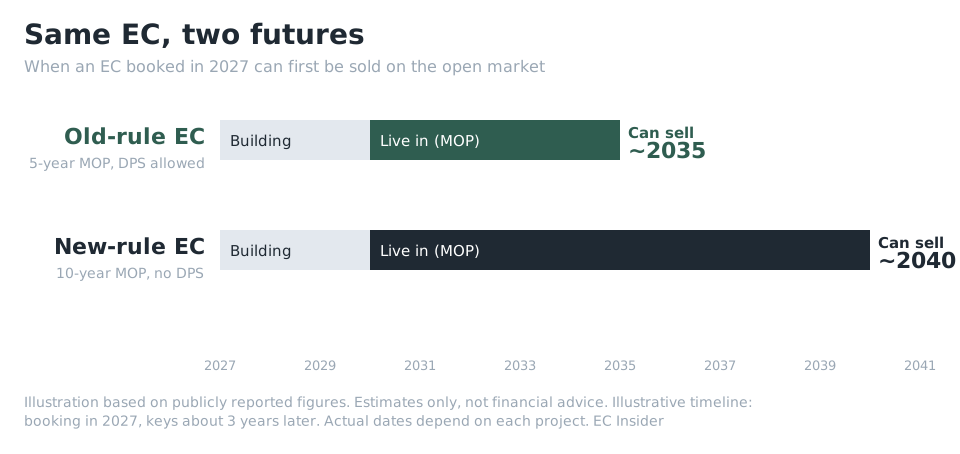
If you expect to upsize, move for work or need the money within ten years, the old rules give you a real option the new rules do not. If you plan to stay for the long term, the difference matters less.
Which ECs fall under the old rules, and which under the new?
Five upcoming ECs keep the old rules because their tenders closed before 8 May 2026. Three sites so far fall under the new rules. Coastal Cabana in Pasir Ris, already selling, is also an old-rule EC.
- Old rules: Wynwood Grand (e-application 11-27 Dec 2026), Solano Grand (8-19 Jan 2027), Sembawang Road EC (target preview Feb 2027), Clovelle of Woodlands (Q2 2027) and Miltonia Close EC (Q3 2027).
- New rules: Canberra Drive (tender closed 1 October 2026, award pending), Admiralty Walk (tender reported to close 17 December 2026) and Jurong East Avenue 1 (on the 2H 2026 Confirmed List).
Miltonia Close is the last site under the old rules: its tender closed on 14 April 2026, just over three weeks before the change.
Should you wait for a new-rule EC or buy an old-rule one?
It depends on your income and how long you plan to stay. Households earning $16,001 to $18,000 can only apply for new-rule ECs. If you can apply for both, an old-rule EC can be sold five years earlier and may offer DPS, while a new-rule EC gives first-timers better odds.
A simple way to decide:
- Choose old rules if you value the 5-year MOP, want DPS while you sell your HDB flat, or are a second-timer.
- Wait for new rules if your income is above $16,000, or you are a first-timer happy to stay ten years.
Read the full new EC rules guide, then run the 30-second eligibility check to see which set applies to your household.
This article is general information based on public sources at the time of writing. It is not financial advice. Policy figures and launch details can change, so confirm them with HDB, CPF Board, your bank and the developer.


