
Comparisons
Is It Worth Buying an EC Under the New Rules? 10-Year MOP Explained

Is it worth buying an EC under the new rules? For many households the answer is yes, but only if you can stay ten years and you do not need a deferred payment. This guide sets out what changed, who gains, who loses, and how to decide, using the figures that are currently reported.
Is it worth buying an EC under the new rules?
It can be, if you are a first-timer who plans to live in the home for a decade. The new rules double the minimum occupation period, remove the Deferred Payment Scheme (DPS) and lift the income ceiling. The trade-offs are real, so match them to your own plans.
The new rules apply to EC sites whose land tender closed on or after 8 May 2026. The income ceiling rise to $18,000 applies to sites whose tender closes on or after 24 August 2026. Sites tendered earlier keep the old rules. Everything below is reported from HDB material, so confirm it on hdb.gov.sg before you commit.
What actually changes under the new EC rules?
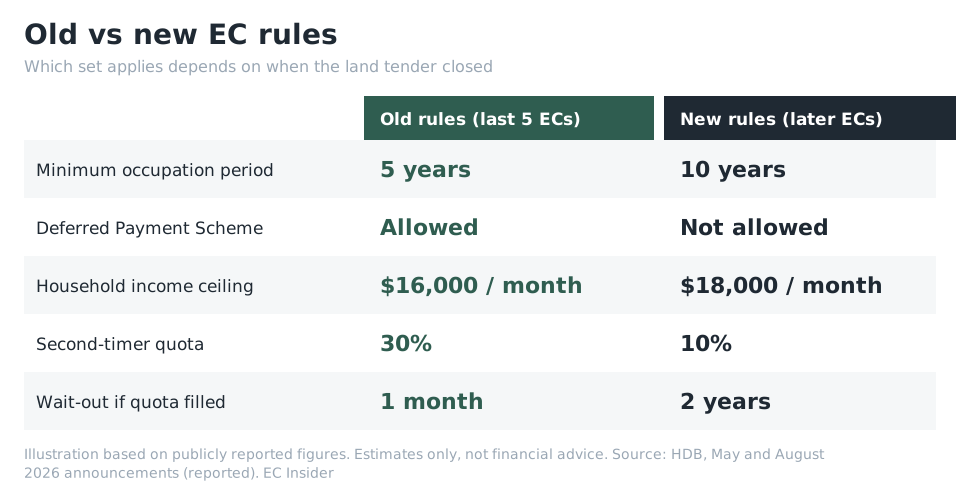
Four things change: the minimum occupation period (MOP) goes from 5 to 10 years, DPS is removed, the second-timer quota falls from 30% to 10%, and the income ceiling rises from $16,000 to $18,000. The table compares them side by side.
| Rule | Old rules (last five sites) | New rules |
|---|---|---|
| Minimum occupation period | 5 years | 10 years |
| Deferred Payment Scheme | Option, developer's choice | Removed |
| Household income ceiling | $16,000 | $18,000 |
| Second-timer quota at launch | 30% | 10% (90% first-timers) |
| Wait-out once quota is filled | 1 month | 2 years |
Who gains from the new rules?
Mainly first-timers and households earning $16,001 to $18,000. A 90% first-timer quota means fewer second-timers competing for the same units, and the higher ceiling opens EC eligibility to families who were previously just over the line. These households cannot apply for the old-rule ECs at all.
The CPF Housing Grant is unchanged in this respect. It is reported at up to $30,000 for two first-timers, and it stops above $12,000 of household income. See our grants guide for the bands.
Who loses out under the new rules?
Anyone who needs flexibility. Ten years is a long time to be tied to one address, so a growing family, a job move or a plan to upgrade again in seven years all become harder. Upgraders who relied on DPS to keep cash free while selling their HDB flat lose that option too.
Second-timers lose most. Their launch quota falls from 30% to 10%, and once it is filled the wait-out is two years instead of one month. If you are a second-timer, an old-rule EC is the more practical route while those sites remain.
How much more do new-rule ECs cost?
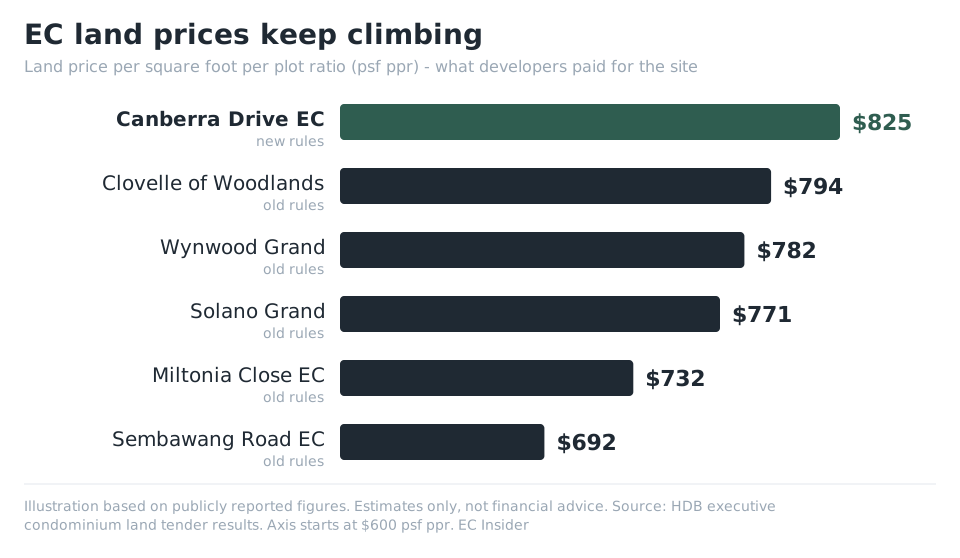
Early signs point to higher land costs. The Canberra Drive site in Sembawang drew 13 bids, the most in eight years, and the top bid is about $825 psf ppr. That would be an EC land record if awarded, and the award is still pending. Wynwood Grand's record-setting land price was $782 psf ppr.
The gap is $43 psf ppr, which is 5.5% higher. Land cost is only one input into a launch price, so do not read this as a price forecast. It does suggest new-rule sites are not starting cheaper.
Is the Deferred Payment Scheme worth missing?
It depends on how you pay. Under DPS you pay about 20% at booking and the rest at TOP, with developers reported to price DPS units 2% to 3% higher. On an example $1,500,000 EC (an assumed figure, not a quote), a 2.5% premium is $37,500.
Without DPS, you follow the normal payment scheme. That means at least 5% in cash, 20% more in cash or CPF early in construction, plus stamp duty. For upgraders this means selling the HDB flat and managing the bank loan sooner. Budget for it with the EC affordability calculator.
Should you wait for a new-rule EC or buy an old-rule one?
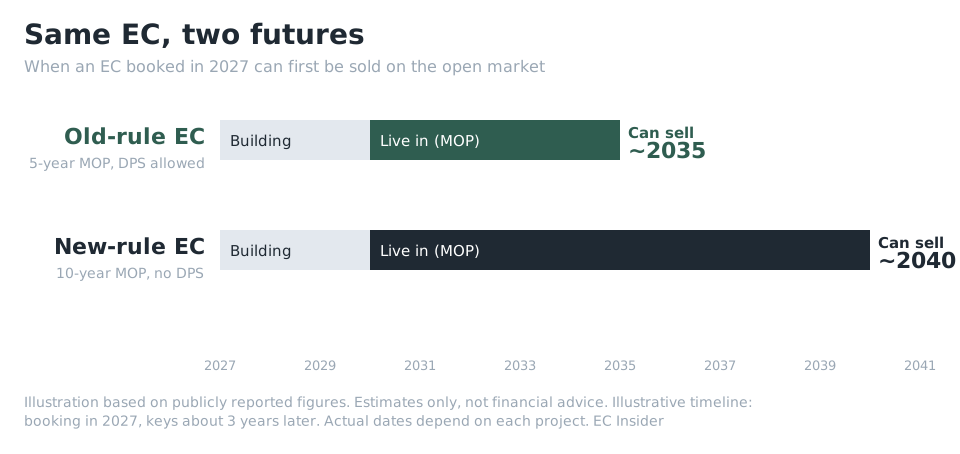
If you can apply for both, an old-rule EC can be sold five years earlier and may offer DPS. A new-rule EC gives first-timers better odds through the 90% quota. If your household earns $16,001 to $18,000, you can only apply for new-rule ECs.
Old-rule launches are close: the E-application for Wynwood Grand is reported for 11 to 27 December 2026, and for Solano Grand 8 to 19 January 2027. Sites under the new rules include Canberra Drive, Admiralty Walk and Jurong East Avenue 1, none of which has a launch date yet.
What is the simplest way to decide?
Ask three questions. Can you live there for ten years? Is your income at or under $16,000, so both rule sets are open? Do you need DPS to bridge the sale of your flat? If you answer yes, yes, no, either route can work. Otherwise let the answers point you.
This is general information, not advice, and prices and rules may change. Start with the old rules versus new rules comparison and then run your own numbers in the EC affordability calculator.
This article is general information based on public sources at the time of writing. It is not financial advice. Policy figures and launch details can change, so confirm them with HDB, CPF Board, your bank and the developer.


